The short version
You have a pile of parts to cut and a stack of stock sheets to cut them from. Nesting is the job of arranging those parts on those sheets so they fit as tightly as possible. Do it by hand and you are dragging shapes around in a CAD drawing, eyeballing the gaps. Nesting software does the same arranging automatically, and it tries far more arrangements than you would have the patience for.
The payoff is measured in sheets. Every part that fits on sheet three instead of sheet four is material you did not buy, handle, or store. On a busy laser or plasma table that adds up quickly, which is why nesting is a standard step in sheet-metal work rather than a nice-to-have.
Rectangular nesting vs true-shape nesting
This is the distinction that matters most, and it is where cheap and serious nesting tools part ways.
Rectangular nesting treats every part as the smallest box that contains it. An L-bracket becomes a rectangle. A ring becomes a square. The software then packs boxes, which is an easy problem to solve, and a wasteful one, because everything inside the box but outside the part is scrap by definition.
True-shape nesting packs the real outline. The tail of one L-bracket slides into the notch of the next. Small parts drop into the middle of a ring instead of sitting beside it. The arithmetic is much harder. For every candidate position and rotation, the software has to work out whether two irregular outlines overlap. But the sheets come out visibly fuller.
If your parts are mostly rectangles, the two approaches land in roughly the same place. The moment your parts have curves, notches, or big internal holes, true-shape nesting is where the savings live.
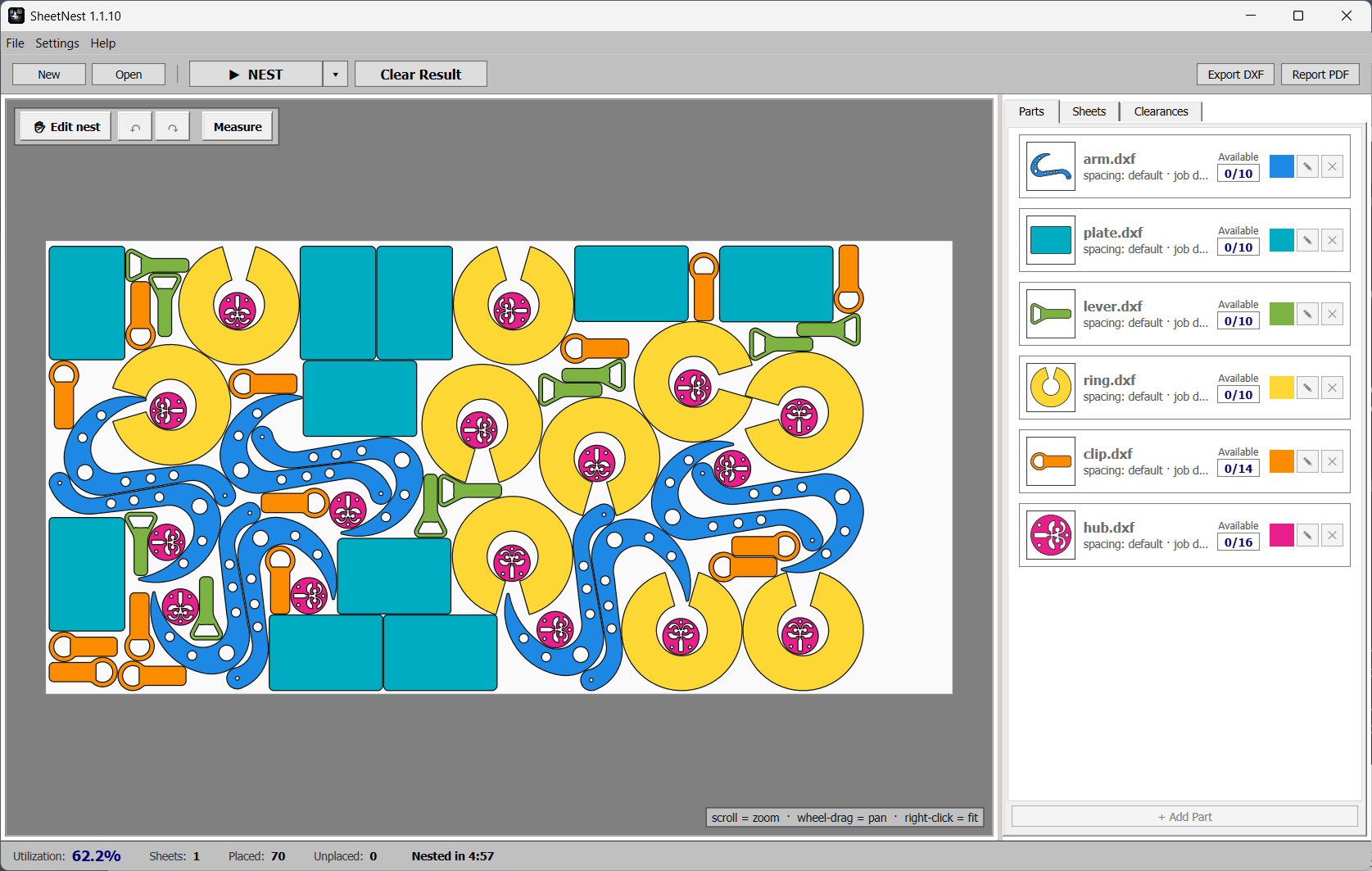
True-shape nesting: parts interlock by their real outline instead of by bounding boxes.
Where the savings actually come from
There are four separate levers, and a good nester pulls all of them:
- Interlocking. Concave parts nest into each other rather than sitting side by side.
- Filling holes. The empty middle of a large ring or frame is usable sheet. Small parts belong there.
- Rotation. Trying a part at many angles, not just at 0° and 90°, often finds a fit that the obvious orientation misses.
- Sheet choice. If you stock more than one sheet size, the densest packing is not always on the biggest sheet. Picking the right size per job is free money.
There is a fifth lever that is about cutting time rather than material: common-line cutting, where two parts share an edge so one pass of the torch or laser cuts both. Fewer pierces, less travel, and the parts sit tighter.
What a nesting program has to get right
Packing tightly is only useful if the result can actually be cut. The things that separate a usable nest from a pretty picture:
- Part spacing. Parts need a gap between them for the kerf (the width of material the beam or arc removes) plus a margin so heat and small positioning errors do not ruin a neighbour. Too tight and parts weld themselves together or come out undersized.
- Sheet margin. Clamps, rails and slat supports mean the extreme edge of a sheet is often unusable.
- Quantities and mirrors. You rarely need one of each. You need eleven of this and four of that, and sometimes a mirrored pair.
- The leftover. When a job does not fill the last sheet, the remnant is worth more as one clean rectangle you can put back on the rack than as an odd-shaped scrap.
- Clean output. Whatever your CAM software reads, it should get geometry and nothing else: no stray construction lines, no duplicate outlines, no text layers.
Nesting software is not CAM software
The two get confused, so it is worth being precise. Nesting decides where the parts go. CAM decides how the machine cuts them: lead-ins, cut order, kerf compensation, pierce settings, and the G-code your controller actually runs.
Some large packages bundle both. They also tend to cost what a bundled package costs. The alternative is to nest separately and hand the finished layout to the CAM software you already own, as a DXF. That keeps the two jobs independent: you can change how you nest without touching how you cut.
Do you need it?
If you cut one or two simple parts at a time, laying them out by hand is fine. Nesting software earns its place when any of these is true:
- You cut mixed jobs: many different parts, in different quantities, on the same sheet.
- Your parts are irregular, with curves, notches, or large internal openings.
- You stock more than one sheet size and have to decide which to use.
- You are quoting, and you need to know how many sheets a job will consume before you commit to a price.
Where SheetNest fits
SheetNest is a free, open-source true-shape nester for Windows. You bring in the DXF drawings you already have, or a 3D STEP or IGES part that it unfolds to a flat pattern for you. Set quantities and the sheet sizes you actually stock, and it lays the job out. It picks the sheet size that packs densest, fills internal holes with smaller parts, supports common-line cutting, and lets you drag anything by hand afterwards with full undo. Then it exports one clean, parts-only DXF per layout for your CAM software, plus a PDF report telling you how many sheets to buy.
It runs fully offline, there is no account or licence key, and it is released under the MIT License.
Download SheetNest for Windows