Same idea, different scope
DeepNest solved the hard part: packing parts by their real outline instead of their bounding box, so irregular shapes interlock and small parts drop into the holes of big ones. That approach is the foundation SheetNest is built on, and credit for it belongs upstream.
What SheetNest sets out to add is everything around the nest: the parts of the job a cutting shop still has to do once the layout looks good. Getting a 3D part flattened. Remembering which sheet sizes are on the rack. Telling purchasing how many sheets to order. Not losing an afternoon's work to a crash.
What SheetNest adds
| Capability | SheetNest |
|---|---|
| True-shape nesting | Kept from DeepNest, with a faster engine. |
| 3D import and unfold | STEP and IGES sheet-metal parts are flattened to a nestable pattern in-app, fully offline, with a per-part K-factor. No CAD seat needed. |
| Common-line cutting | Matching parts snap onto a shared edge so one pass cuts both: fewer pierces, less travel, tighter sheets. |
| Sheet stock per project | List the sizes you actually stock; the nester picks the one that packs densest. Saved as reusable presets. |
| Manual editing | Drag, rotate, mirror and nudge parts, drop them to contact at exactly your spacing, with full undo/redo. |
| PDF purchasing report | Sheets to buy per size, total area, part totals, the cutting plan, and a scaled drawing of each layout. |
| Leftover handling | An unfilled last sheet can be cut down to one clean remnant worth putting back on the rack. |
| Windows installer | A per-user .msi that needs no admin rights, plus autosave, crash recovery, a backup on every save, and project files that remember their stock and finished nest. |
| Measurements | Built-in Measure tool, inches or millimetres. |
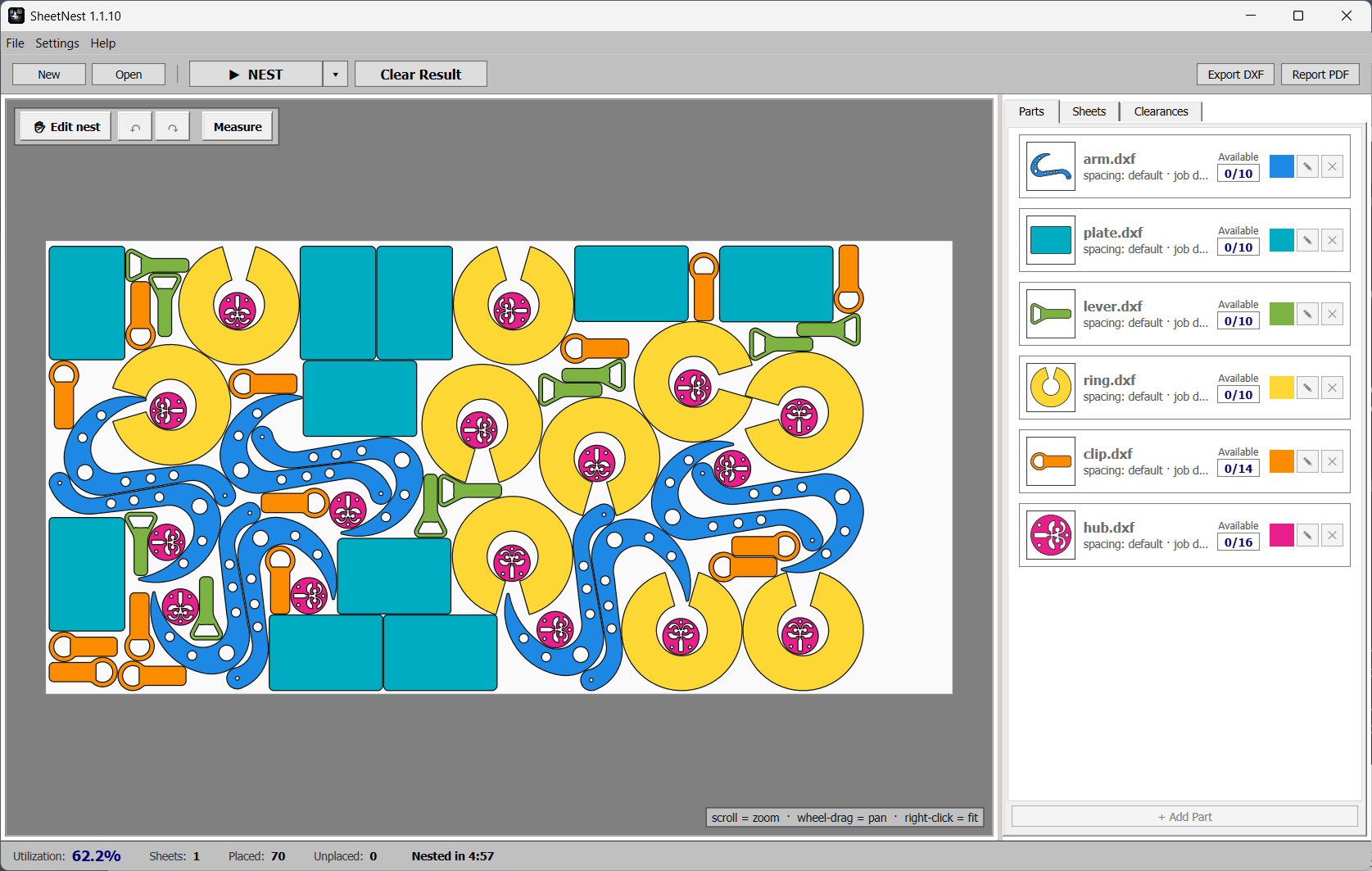
True-shape nesting, inherited from DeepNest and rebuilt around a shop workflow.
Where DeepNest is still the better choice
Worth saying plainly, because the answer is not always SheetNest:
- You are not on Windows. SheetNest is a Windows 10/11 application. If you work on macOS or Linux, it is not an option for you and DeepNest is.
- Your work is SVG-based. SheetNest is built around DXF for parts and STEP/IGES for 3D. If your parts live as SVG, which is common in laser-cut signage, craft and hobby work, that is DeepNest's home ground.
- You already have a workflow that works. Nothing here is a reason to change a setup that is doing its job.
Moving over
There is no migration as such, because nesting is stateless. You bring the same part drawings and get on with it:
- Install SheetNest. It is a per-user .msi, so no admin rights are needed, and the 3D unfolding engine is bundled inside, with nothing else to install.
- Import the same DXF part files you were nesting before.
- Enter the sheet sizes you stock and save them as a preset. This is the one bit of setup, and it is a one-off.
- Set part spacing to cover your machine's kerf plus a safety margin, exactly as before.
- Nest, adjust by hand if you want to, and export one clean, parts-only DXF per sheet for the CAM software you already use.
Nothing about your machine or your CAM setup changes. SheetNest decides where parts go; how they get cut stays where it always was.
The full walkthrough is here: how to nest DXF files.
Licence, cost and source
SheetNest is free and open-source under the MIT License. There is no account, no subscription, no licence key, and no locked "pro" tier. The download on this site is the whole program. It runs fully offline; the only online touch is the optional version check on the download button.
The source, the issue tracker and every release live on GitHub. If something nests badly, that is the place to say so. Bug reports with the offending DXF attached are the fastest way to get it fixed.
Download SheetNest for Windows