Three things plasma changes
The nesting problem is the same, fitting the most parts on the sheet, but three physical realities of plasma cutting push the answer around.
1. The kerf is wide, and it moves
A plasma arc removes a noticeably wider band of material than a laser does, and that width is not a fixed property of the machine. It changes with amperage, with cut speed and with material thickness. And with the one that catches people out: consumable wear. A worn nozzle cuts a wider, less square kerf than a fresh one.
For nesting, the consequence is simple: part spacing set from a laser's habits is too tight. The gap between neighbouring parts has to swallow the kerf plus the drift, or a job that cut fine on Monday starts producing parts that touch by Friday.
2. There is a real heat-affected zone
Plasma puts a lot of heat into a small area. On thin material especially, that shows up as distortion: the sheet moves while you are cutting it. Parts packed shoulder to shoulder both transfer heat to each other and give the sheet less unheated material to hold its shape.
A little extra spacing on thin gauge is not wasted material. It is the difference between flat parts and parts you have to flatten.
3. Every pierce costs you
Piercing is the hardest thing a plasma consumable does. Molten material blows back at the nozzle, and pierce count is one of the main things that determines how long a set of consumables lasts. On a laser, an extra pierce costs a second; on plasma, it costs part of a nozzle.
That changes what a good nest looks like. Packing density is not the only score. A layout that gets the same parts out with fewer pierces is worth real money.
What to set, and why
- Part spacing: at least your measured kerf plus a working margin. If you have never measured it, cut two parallel lines a known distance apart, measure the finished gap, and you have your number: with your consumables, at your amperage, on your material.
- More space on thin material: where distortion is worst, not less. The instinct to tighten up on cheap thin sheet is the wrong one.
- Sheet margin: keep parts off the extreme edge. Slats support the sheet unevenly near the edges, and an unsupported edge is where a part tips into the water table.
- Common-line cutting where the parts allow it: two parts sharing a straight edge means one cut instead of two and one pierce instead of two. On plasma the pierce saving is the bigger prize.
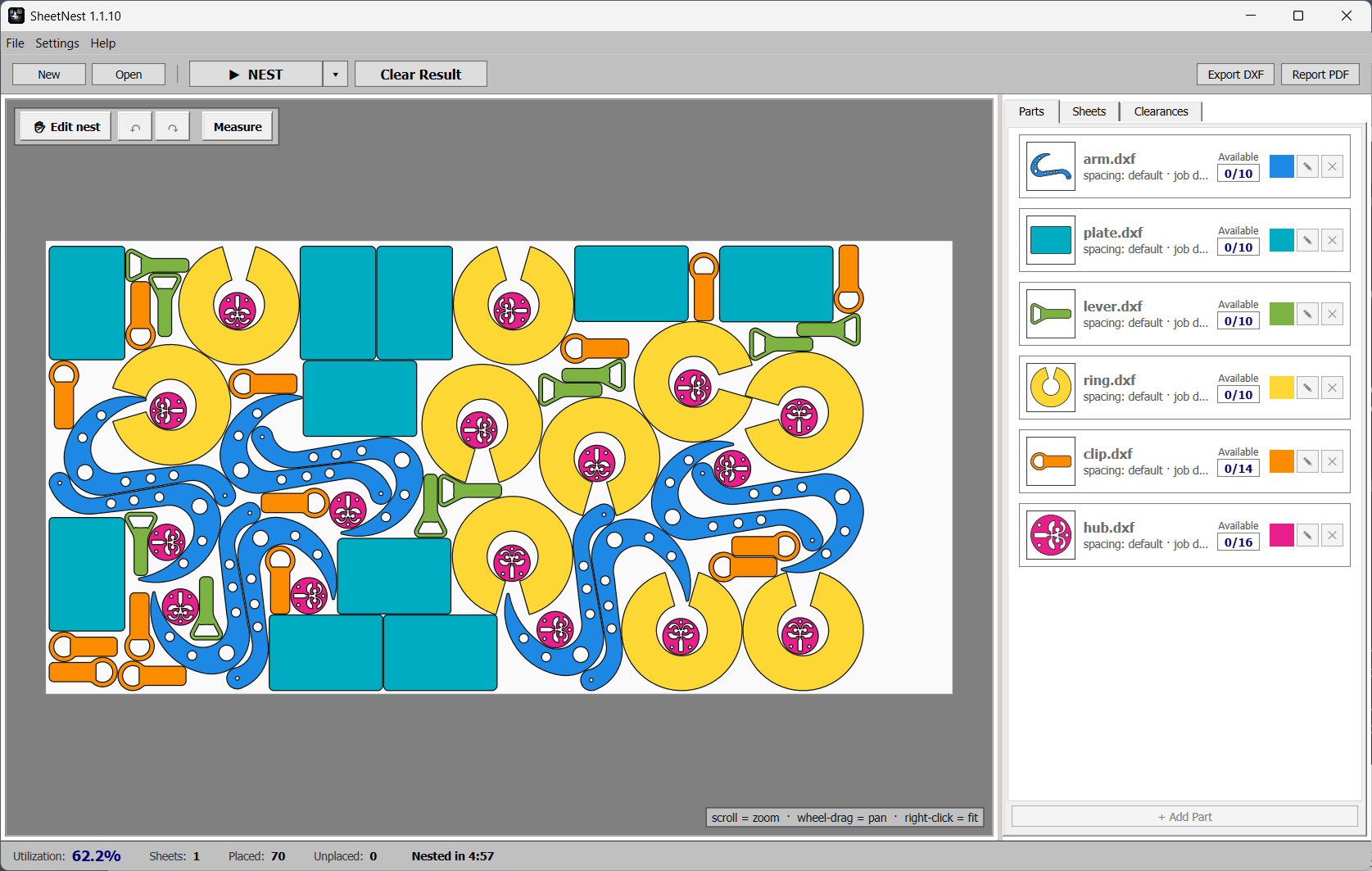
Parts packed by their true outline, with the spacing your table actually needs.
Where SheetNest fits in a plasma shop
SheetNest handles the layout and hands off cleanly to whatever drives your table:
- True-shape nesting. Parts interlock by their real outline, and small parts drop into the middle of big ones instead of sitting beside them.
- Your spacing, enforced even while you drag parts by hand. A part dropped to contact settles at exactly the gap you set, not wherever the mouse was.
- Common-line cutting. Snap matching parts onto a shared edge deliberately, rather than hoping the layout produces one.
- Your stock sizes. List what is on the rack and let it pick the sheet that packs densest. Saved as a preset for next time.
- The leftover kept usable. When a job does not fill the last sheet, cut the remnant down to one clean piece worth racking instead of an awkward offcut.
- One clean DXF per sheet, parts only, with nothing else for your CAM software to trip over.
- A PDF report with sheets to buy per size, total area, part totals and a scaled drawing of every layout. Useful for quoting before the torch fires.
It runs on Windows 10 and 11, installs per-user without admin rights, works fully offline, and is free and open source under the MIT License, with no account, no subscription and no licence key.
Download SheetNest for WindowsIt does not replace your CAM software
Worth being explicit. SheetNest decides where the parts go. Your CAM software decides how the torch cuts them: lead-ins and lead-outs, kerf compensation, pierce height and delay, cut order, and the G-code your controller runs. SheetNest exports a DXF; from there your existing setup carries on unchanged.
That separation is deliberate. You can change how you nest without touching a machine setup that took you a long time to get right.